
Muscles Weakening in Youth: It Could Be Sarcopenia—Consult a Doctor to Learn About Symptoms, Risk Factors, and Preventive Measures.
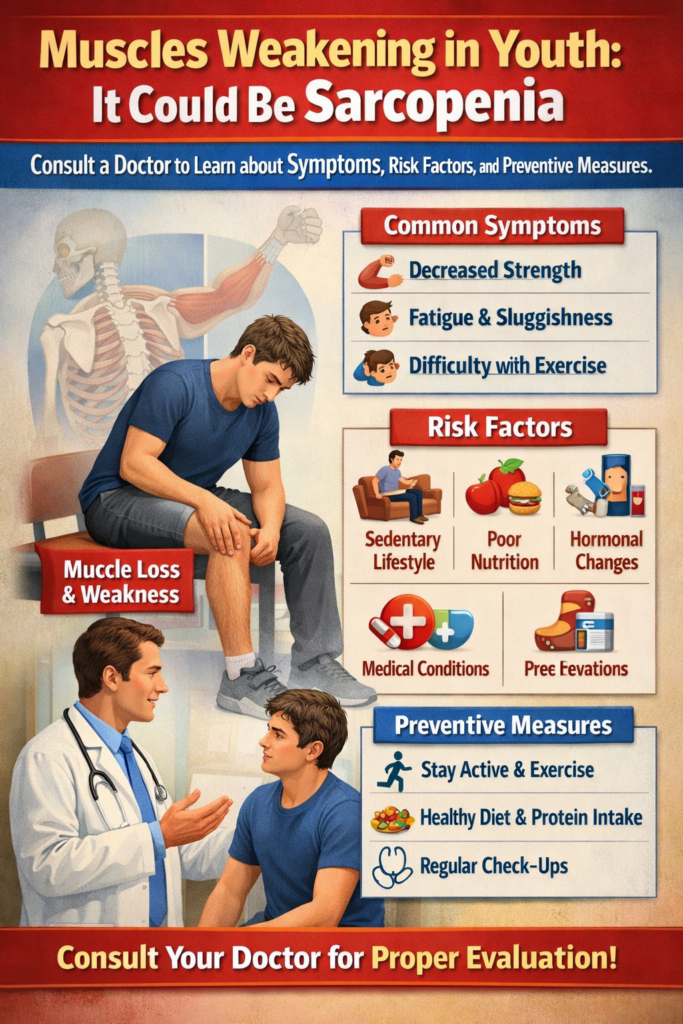
Imagine you are 35 years old. You no longer possess the same agility you once had when climbing stairs. Even lifting a light weight leaves you breathless. These changes could be a sign of a silent underlying condition known as ‘sarcopenia.’
Typically, this condition affects older adults; however, due to a sedentary lifestyle, it can begin as early as one’s 30s or 40s. In such cases, the condition tends to become severe by the time one reaches old age.
According to a study published in the ‘National Library of Medicine’ in 2024, approximately 28% of people in India aged 35 to 70 are suffering from sarcopenia.
What is Sarcopenia?
What are its early signs?
What lifestyle changes can be made to prevent it?
Question: What is Sarcopenia?
Answer: Sarcopenia is a medical condition in which:
As one ages, muscle mass (the muscles present in the body) begins to decline.
Muscle strength starts to diminish.
Mobility becomes difficult.
Even minor daily tasks begin to feel arduous.
Typically, this condition affects the elderly more frequently.
Question: What causes Sarcopenia?
Answer: Sarcopenia is the result of various physiological changes that occur in the body with aging. The following bodily changes are responsible for this condition:
The number of nerve cells begins to decrease; consequently, muscles do not receive proper signals.
Growth hormone levels decline.
Testosterone and IGF-1 hormone levels are adversely affected.
Testosterone regulates muscle mass, strength, energy levels, and sex drive within the body.
IGF-1 is responsible for growth, muscle synthesis, and cellular repair within the body.
The body becomes less efficient at utilizing dietary protein for building and repairing muscles compared to its younger years.
Chronic diseases lead to increased inflammation within the body.
While muscle mass naturally declines with age, the rate of this decline accelerates significantly in cases of Sarcopenia.
Question: What are the symptoms of Sarcopenia?
Answer: This condition impacts an individual’s daily life and functional activities. It causes difficulty in walking and moving, and leads to a deterioration in balance.
Question: How does sarcopenia affect the body?
Answer: The impact of sarcopenia is not limited solely to the muscles; it also affects the body’s strength, balance, and daily life.
Impact on Daily Life:
Physical strength diminishes.
Fatigue sets in quickly.
Walking speed slows down.
Balance begins to deteriorate.
The risk of falls and injuries increases.
Climbing stairs becomes difficult.
Lifting objects becomes challenging.
Standing for prolonged periods becomes arduous.
Even minor tasks begin to feel burdensome.
Impact on Health:
Bones may become weak.
The risk of fractures increases.
Metabolism slows down.
Obesity may develop rapidly.
In severe cases, the individual may become dependent on others.
Question: How is sarcopenia diagnosed?
Answer: Let’s understand this through the following points:
Typically, doctors diagnose the condition based on physical examinations and the patient’s symptoms.
During this process, the patient is asked questions regarding their daily activities and any associated weakness.
Muscle strength is assessed using self-reported questionnaires.
If the score obtained during this initial self-assessment is high, further diagnostic tests are conducted.
Question: Does the risk of sarcopenia increase in women after menopause?
Answer: Yes, the risk increases due to hormonal changes that occur after menopause. Let’s understand all the underlying reasons through the following points:
During menopause, levels of the hormone estrogen decline rapidly in the body.
This hormone is essential for muscle strength and recovery. A deficiency in estrogen causes muscles to begin breaking down at an accelerated rate.
The process of generating new muscle tissue also slows down.
According to a study published in the National Library of Medicine, the prevalence of sarcopenia in women is:
5.5% during the pre-menopausal stage.
This figure rises to 7.43% during the post-menopausal stage.
The risk increases even further during the late post-menopausal stage.
Question: Can the risk of sarcopenia be reduced through diet?
Answer: Yes, the risk of sarcopenia can be significantly reduced with the help of a healthy and balanced diet.
According to the Journal of Food Biochemistry, a balanced diet helps maintain muscle health. Essential nutrients also play a crucial role in improving muscle function.