
What Your Summer Skincare Routine Should Look Like: Understand Your Skin Type and Its Needs with a Dermatologist—Avoid These 8 Mistakes.
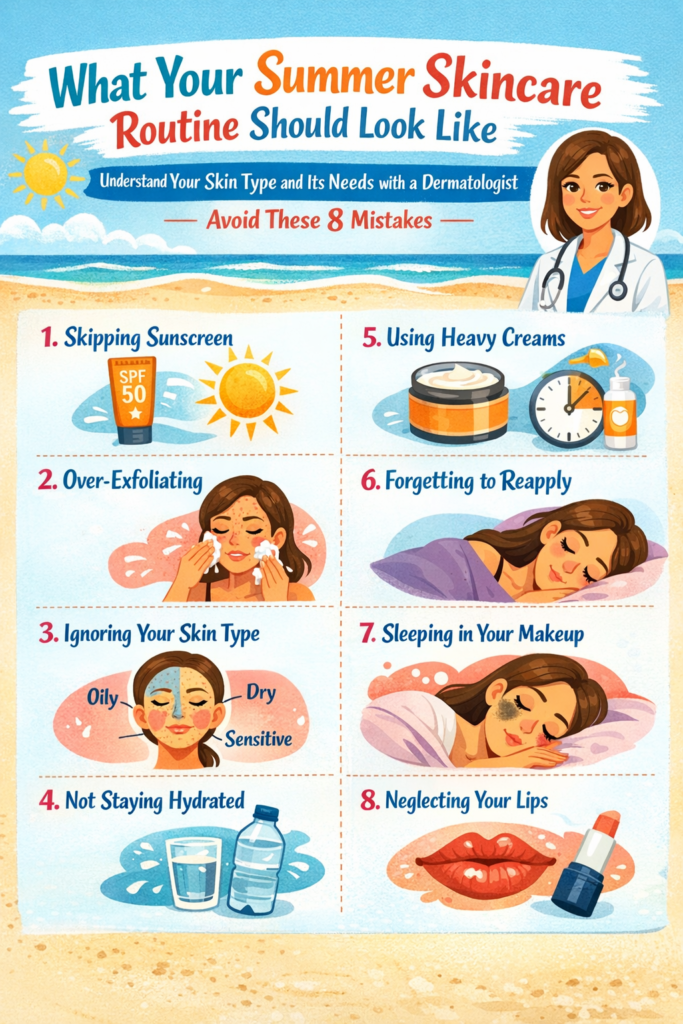
During the summer, along with changes in clothing and diet, the needs of your skin also evolve. Intense sunlight, perspiration, and pollution have a direct impact on the skin. Consequently, if you continue to follow your winter skincare routine, your skin may become oily, dull, or prone to acne.
In fact, during the summer months, UV (ultraviolet) rays and humidity can damage the skin’s protective barrier. This increases the risk of tanning, pigmentation, and skin infections.
Therefore, in this edition of ‘Zaroorat Ki Khabar’ (Essential Insights), we will explore:
What should your skincare routine look like during the summer?
Which common mistakes can harm your skin?
How can you keep your skin healthy and glowing throughout the summer?
Question: Why is it necessary to change your skincare routine during the summer?
Answer: This is not merely a trend, but a scientifically grounded necessity. Changing your skincare routine during the summer is essential for the following reasons:
Excessive Sweating:
Summer weather leads to increased perspiration.
This causes skin pores to become clogged, leading to a rise in pimples and rashes.
UV Rays:
Sunlight is more intense during the summer, and UV rays strike the skin directly.
This significantly increases the risk of tanning, sunburn, and pigmentation issues.
Dehydration:
Intense heat and sweating can deplete the body’s water levels.
This results in the skin becoming dry and dull.
Question: Does the skincare routine differ for every skin type?
Answer: Yes, every skin type has unique needs. Each skin type presents different concerns and reacts in its own distinct way. Therefore, a single product or approach will not be effective for everyone.
Question: What should be the complete summer skincare routine tailored to every skin type?
Answer: See the complete step-by-step process below:
- Oily Skin
Morning
Wash your face with a face wash.
The face wash should be gel-based.
Apply an alcohol-free toner.
Apply an oil-free moisturizer.
Apply SPF 30+ sunscreen.
Night
Wash your face with a face wash before going to bed.
Apply an oil-control serum.
Apply a moisturizer.
Weekly
Apply a clay mask 2 to 3 times.
This absorbs excess oil.
Exfoliate (scrub) 1–2 times.
Dry Skin
Morning
Wash your face with a face wash.
The face wash should be cream-based.
Apply a hydrating toner.
Follow with a moisturizer.
The moisturizer should be ceramide- or hyaluronic acid-based.
Apply a hydrating sunscreen.
Night
Wash your face with a face wash.
Apply a hydrating serum.
Apply a night cream.
Weekly
Apply a hydrating mask 1–2 times.
Exfoliate your face 1–2 times.
Avoid excessive scrubbing.
Combination Skin
Morning
Wash your face with a mild face wash.
Apply a lightweight moisturizer.
Follow with sunscreen.
The sunscreen should not be greasy.
Apply an oil-control serum to the T-zone.
Night
Wash your face with a face wash.
Apply a light hydrating serum.
Apply a moisturizer.
Weekly
Apply an oil-control clay mask to the T-zone.
Apply a hydrating clay mask to the cheeks.
Exfoliate 1–2 times.
Sensitive Skin
Morning
Wash your face with a gentle face wash.
The face wash should be fragrance-free.
Apply an aloe vera-based moisturizer.
Apply a mineral-based sunscreen. Ensure your sunscreen contains zinc oxide.
Night
Wash your face.
Apply an aloe vera-based moisturizer.
Weekly
Apply a soothing face mask.
Do not scrub your face.
Question: Why does the skin become excessively oily during the summer?
Answer: See the points below for the explanation:
The skin contains sebaceous glands, which produce sebum (i.e., oil). As temperatures rise during the summer, these glands become more active.
Increased sweating occurs during the summer. When oil and sweat combine, the skin becomes sticky.
Summer also brings humidity, which prevents the oil from evaporating, causing it to remain stuck to the skin.
Consequently, the skin’s pores tend to get clogged more easily.
Hormones also play a role in influencing oil production.
Question: Can following a winter skincare routine during the summer be harmful?
Answer: Yes, because the skin’s needs are entirely different during these two seasons.
The needs of the skin vary with every season. Therefore, it is essential to adjust your skincare routine according to your specific needs and concerns.
Question: What kind of skin problems can arise from following an incorrect skincare routine?
Answer: An improper skincare routine can damage the skin in various ways. If you continue to follow your winter skincare routine during the summer months, it can exacerbate a range of issues—from pimples to pigmentation problems.
Question: How many times a day should one wash their face with a face wash?
Answer: You should wash your face twice a day—after waking up in the morning and before going to sleep at night.
Question: Is it okay to wash one’s face with a face wash 3–4 times a day?
Answer: No. Excessive face washing can lead to:
Dry skin.
Disruption of the natural oil balance.
Increased oil production.
Question: Is it necessary to use a toner during the summer?
Answer: It is not strictly mandatory. However, applying an alcohol-free toner after washing your face is beneficial for the skin.
Question: Should one use a moisturizer even during the summer?
Answer: Yes, using a moisturizer is essential even in the summer. It is necessary for every skin type because:
It keeps the skin hydrated.
It strengthens the skin barrier.
It balances oil production.
It protects against dryness and irritation.
If you do not use a moisturizer, your skin tends to produce excess oil.
Question: What SPF level of sunscreen should be used during the summer?
Answer: When choosing a sunscreen, consider your daily activities:
Indoor Jobs (those who spend most of their time indoors at home or the office) — SPF 30 Sunscreen
Outdoor Jobs (those who spend a significant amount of time in the sun) — SPF 50 Sunscreen
Question: How many times a day should sunscreen be applied?
Answer: Applying it just once is not sufficient. Therefore:
Apply it in the morning after washing your face.
If you are going outdoors, re-apply every 3–4 hours.
If you are exposed to intense sunlight, re-apply every 2 hours.
Re-apply if you are sweating profusely.
Question: Should sunscreen be applied even when indoors?
Answer: Yes, you should apply sunscreen even while indoors in the following situations:
If you sit near a window.
If direct sunlight enters your home.
If you use a laptop or mobile device frequently.
If you have skin pigmentation issues or acne.
Question: Can sweating worsen pimples and rashes?
Answer: Yes, excessive sweating can exacerbate these skin problems.
Question: Does frequently applying makeup during the summer cause damage to the skin?
Answer: Yes, it can lead to skin damage. Here is the reason why:
Makeup mixes with sweat and natural oils, thereby clogging the pores. This can lead to an increase in acne and blackheads.
Makeup tends to melt during the summer heat, which causes layers to build up on the skin.
Applying makeup to sweaty skin can foster bacterial growth, potentially leading to pimples and skin irritation.
Just making sure I’m playing on the right OKBet site for the Philippines! Always double-check, you know? okbetphilipines helped me confirm. Safety first, always!
Hola! Gonna give gameuw88vn a whirl. Supposedly has some killer graphics. Fingers crossed for some smooth gameplay! Check it out yourselves at gameuw88vn.