
What Is Your Waist Size? Keeping Belly Fat in Check Lowers the Risk of Heart Attack: 6 Basic Rules for Reducing Belly Fat.
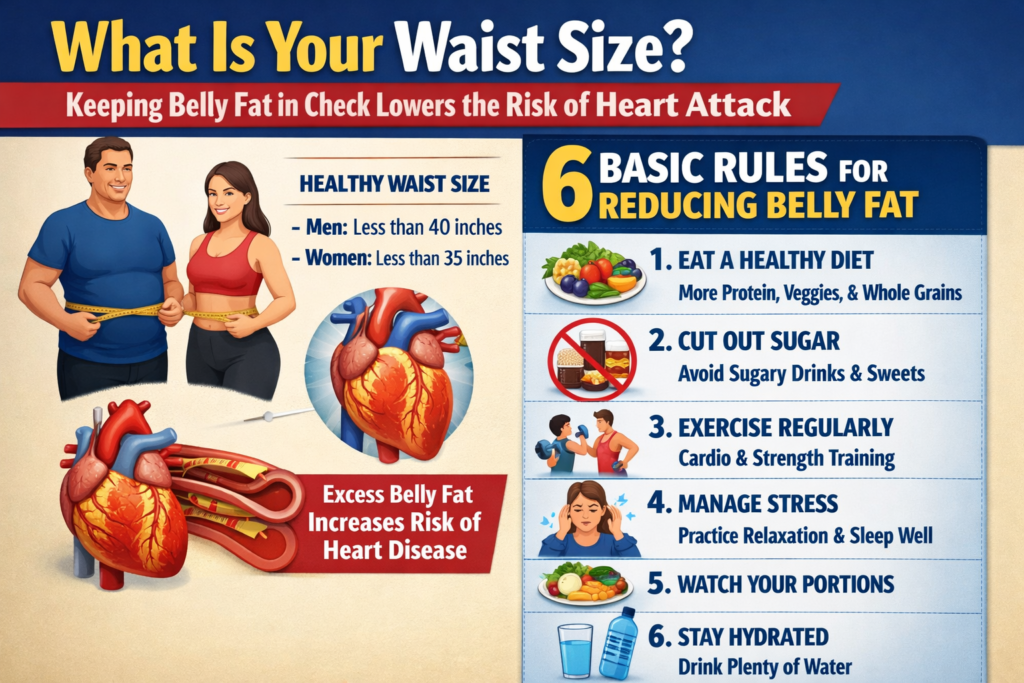
Last month, a conference hosted by the American Heart Association (AHA) took place in Boston. During this event, Taiwan’s National Yang Ming Chiao Tung University presented its research findings. According to this study, belly fat (abdominal fat) increases the risk of heart disease—particularly heart failure.
According to the World Health Organization (WHO), obesity has reached epidemic proportions. An epidemic is defined as a disease that is spreading very rapidly across the globe. Every year, 2.8 million adults worldwide die from life-threatening diseases linked to obesity.
Therefore, in today’s edition of ‘Essential News’ (Zaroorat Ki Khabar), we will discuss the subject of belly fat. We will also explore:
Why does it increase the risk of a heart attack?
Who is at a higher risk of accumulating belly fat?
How can it be reduced?
Question: What connection between belly fat and heart failure was revealed in recent research?
Answer: According to new research, belly fat may increase the risk of heart failure.
The primary reason for heart failure linked to belly fat is inflammation:
Belly fat increases inflammation within the body.
This leads to damage to blood vessels.
This negatively affects heart tissue.
Consequently, the risk of heart failure increases.
Question: What is the difference between BMI and belly fat?
Answer: Both BMI (Body Mass Index) and belly fat are important health parameters, but they reveal different aspects of one’s health.
BMI
This is a key parameter used to assess obesity. It determines whether a person is obese or not by calculating the ratio of their height to their weight. However, BMI does not indicate where fat is distributed within the body. It can be used to determine whether a person is:
Underweight.
Of normal weight.
Overweight.
Or falls into the obese category.
Belly Fat
Belly fat refers to the fat accumulated around the abdomen. It can be assessed by measuring one’s waist size. A healthy individual’s waist size should be less than half of their height. For example, if a person is 170 centimeters tall, a fit individual’s waist size should be less than 85 centimeters.
Question: People commonly regard BMI as the standard parameter for a healthy body. Is this scientifically accurate?
Answer: BMI has long been utilized as an essential tool for assessing obesity. It gained popularity because it is simple and inexpensive to calculate. While it helps in understanding risk trends, it is not entirely scientifically precise. Consequently, it has certain limitations:
It cannot distinguish between fat and muscle.
An individual (such as an athlete) may be highly muscular.
BMI might classify them as overweight, even though they are physically fit. It is impossible to tell where fat is deposited.
BMI cannot indicate whether fat is distributed throughout the body or concentrated primarily in the abdomen.
Yet, belly fat is significantly more dangerous.
Question: Are belly fat and visceral fat different?
Answer: No, they are not different; rather, they are interconnected. Here is how:
What is Belly Fat?
The fat accumulated around the abdomen is referred to as belly fat. It is of two types:
Fat accumulated beneath the skin (Subcutaneous Fat)
Fat accumulated around internal organs (Visceral Fat)
What is Visceral Fat?
It is a specific type of belly fat.
It accumulates within the internal organs.
It is found surrounding the liver, intestines, and other organs.
It is not necessary that visceral fat will always be visible from the outside.
Question: How does the fat accumulated on the abdomen harm the heart?
Answer: Belly fat causes harm to the heart internally in several ways.
Question: What should one eat—and avoid eating—to reduce belly fat?
Answer: Diet plays the most crucial role in reducing belly fat. What a person consumes determines whether their body will build muscle or accumulate fat. Therefore, understand exactly what you should and should not eat:
What to Eat?
- Protein
Vegetarian: Lentils (Dal), Kidney Beans (Rajma), Chickpeas, Paneer (Cottage Cheese), and Yogurt.
Non-Vegetarian: Eggs, Chicken, and Fish.
- Fiber
Fruits/Vegetables: Spinach, Bottle Gourd, Apples, and Guavas.
Whole Grains: Oats and Brown Rice.
- Healthy Fats
Dry Fruits: Almonds and Walnuts.
Seeds: Flaxseeds and Chia Seeds.
- Probiotic Foods
Dairy Products: Yogurt and Buttermilk.
- Water
2.5–3 liters per day.
Coconut water.
What to Avoid?
- Sweets
Desserts (Mithai), Cakes, and Sugar.
Cold Drinks and Packaged Juices.
- Refined Carbs
Refined Flour (Maida) items: Naan, Pizza, and Bread.
Packaged Biscuits and Savory Snacks (Namkeen).
- Processed and Junk Food
Chips and Fried Foods.
Packaged Snacks.