
Bones Weaken After 40: Do Not Ignore These 10 Warning Signs—Learn 11 Tips for Strengthening Bones from a Doctor.
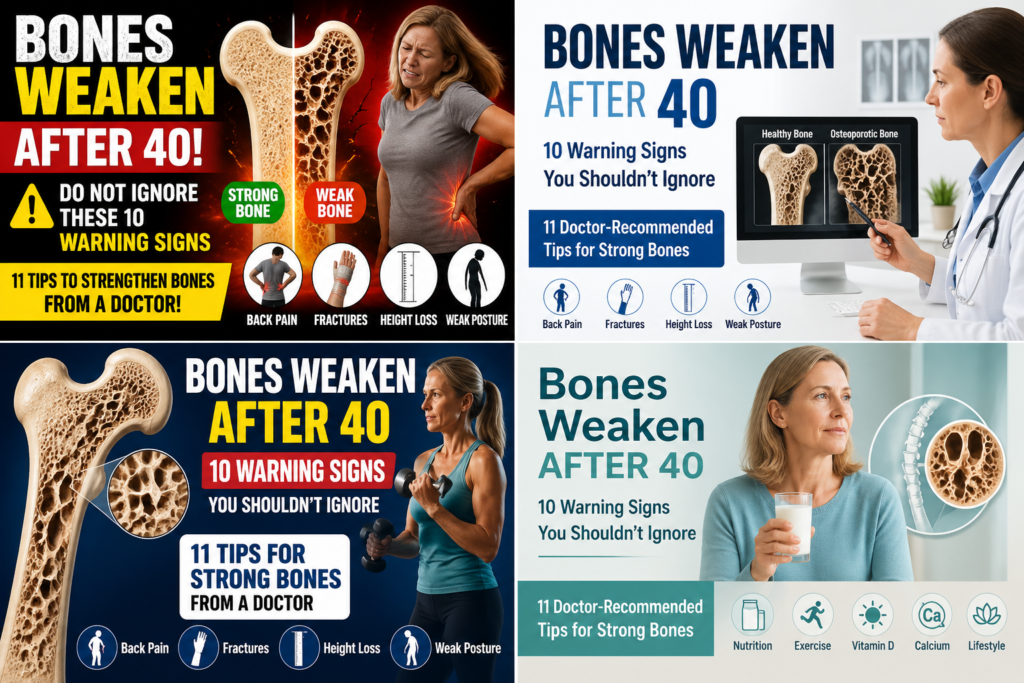
After the age of 40, bone weakness becomes a “silent” problem that progresses gradually. It often manifests only when a fracture or pain occurs. In reality, as the body ages, calcium absorption decreases, and bone density begins to decline.
In women, this process accelerates significantly following menopause. A poor lifestyle, Vitamin D deficiency, lack of exercise, and an improper diet can further heighten this risk.
The concerning aspect is that, in the initial stages, the symptoms are not very distinct; consequently, people tend to overlook them. However, if addressed in a timely manner, the process of bone loss can be slowed down to some extent.
Table of Contents
What are the signs of weak bones?
What kind of lifestyle is necessary for strong bone health?
Calcium Deficiency
As we age, the body’s ability to absorb calcium diminishes.
If the diet does not provide sufficient calcium, the body begins to draw calcium from the bones. This causes the bones to start weakening.
Vitamin D Deficiency
Vitamin D facilitates the absorption of calcium within the body.
A deficiency occurs due to limited exposure to sunlight and a poor lifestyle. This leads to weakened bones.
Hormonal Changes (Especially in Women)
In women, levels of the hormone estrogen decline rapidly following menopause.
This hormone plays a crucial role in maintaining bone strength.
A deficiency in this hormone can accelerate bone loss.
Bone Remodeling Imbalance
Our bones are constantly undergoing a process of breakdown and regeneration.
By the age of 30–35, bones typically reach their peak strength.
After the age of 40, the rate at which bone tissue breaks down accelerates, while the rate of bone formation slows down.
Consequently, the bones gradually become thinner and weaker.
Low Physical Activity
After the age of 40, most people tend to become less physically active.
Physical activity is essential for maintaining bone strength.
A lack of such activity leads to weakened bones.
Poor Lifestyle
Excessive consumption of salt, junk food, caffeine, and alcohol—as well as smoking—depletes calcium from the bones and reduces bone density.
Certain Diseases and Medications
Conditions such as thyroid disorders and kidney disease can weaken the bones.
Long-term use of steroids can also result in weakened bones.
Question: What are the signs of bone weakness?
Answer: The early signs of bone weakness are often very subtle; consequently, people frequently overlook them. However, if these symptoms are recognized in a timely manner, more serious complications can be averted.
Question: Who is at a higher risk of bone loss after the age of 40?
Answer: Certain individuals face a higher risk of bone loss. Physical, lifestyle, and medical factors are responsible for this. See the points below to identify those at increased risk:
Those with a calcium or Vitamin D deficiency.
Those who are physically inactive.
Those who smoke or consume alcohol.
Those with a very low BMI.
Those with a family history of bone diseases.
Those with thyroid disorders.
Those suffering from kidney disease.
Those with rheumatoid arthritis.
Those currently taking medication.
Those with limited exposure to sunlight.
Those with an unhealthy lifestyle.
Those over the age of 50.
Women who have reached menopause.
Question: What diseases is one at increased risk of developing due to weak bones?
Answer: Weak bones can increase the risk of several serious diseases, often accompanied by pain or fatigue. This risk becomes even higher after the age of 40.
Question: How is bone health assessed?
Answer: Bone health cannot be accurately assessed based solely on symptoms; it also requires specific tests and medical evaluations. These include:
BMD (Bone Mineral Density) Test
This test measures the density of the bones.
A DEXA (Dual-Energy X-ray Absorptiometry) scan is performed.
It reveals whether the bones are normal, weak, or if the patient has osteoporosis (a condition characterized by thinning or weakening of the bones).
X-rays
These reveal the structure of the bones and help detect fractures.
However, early-stage bone loss is typically not visible in X-rays.
Blood Tests
Levels of Calcium and Vitamin D are checked.
These tests can also help detect thyroid issues or other underlying medical conditions.
This helps in identifying the underlying causes of bone weakness.
FRAX Score (Fracture Risk Assessment Tool)
This is a calculation tool.
It estimates the risk of fractures based on factors such as age, weight, lifestyle, and medical history.
Physical Indicators
Doctors make an assessment based on certain signs and symptoms, such as:
Recurrent fractures
Persistent bone pain
Lifestyle factors (diet, exercise)
Medical history
Question: What impact does lifestyle have on bone health?
Answer: A balanced diet, regular exercise, and adequate sun exposure strengthen the bones. Conversely, poor dietary habits, low physical activity, smoking, and drinking weaken them. Unhealthy habits gradually diminish bone density and, over time, can increase the risk of osteoporosis.
Common Questions and Answers Regarding Bone Health
Question: Can bone health be assessed without undergoing any tests?
Answer: No; relying solely on symptoms does not provide an accurate assessment. Diagnostic tests are essential for a proper evaluation.
Question: Can bone loss be completely prevented?
Answer: Not entirely, but it can be significantly slowed down through a proper diet, regular exercise, and a healthy lifestyle.
Question: Should everyone undergo a bone density test after the age of 40?
Answer: Yes; however, it is particularly crucial for those at higher risk—such as:
Women who have reached menopause.
Individuals with a history of fractures.
Those suffering from calcium or Vitamin D deficiency.
Individuals taking steroids for an extended period.
Question: Can bones be strengthened simply by taking supplements?
Answer: No; in addition to supplements, a balanced diet and a healthy lifestyle are also essential.
Question: In which situations is it necessary to seek medical advice?
Answer: It is necessary to consult a doctor in the following situations:
If you experience persistent bone pain without any apparent cause.
If a bone fractures as a result of a minor impact or injury.
If you experience difficulty walking or have issues with balance.
If you suffer from weakness, fatigue, or muscle pain.
If there is a family history of bone diseases.
If you have been taking steroids or other medications for a prolonged period.
If you are over the age of 50.