
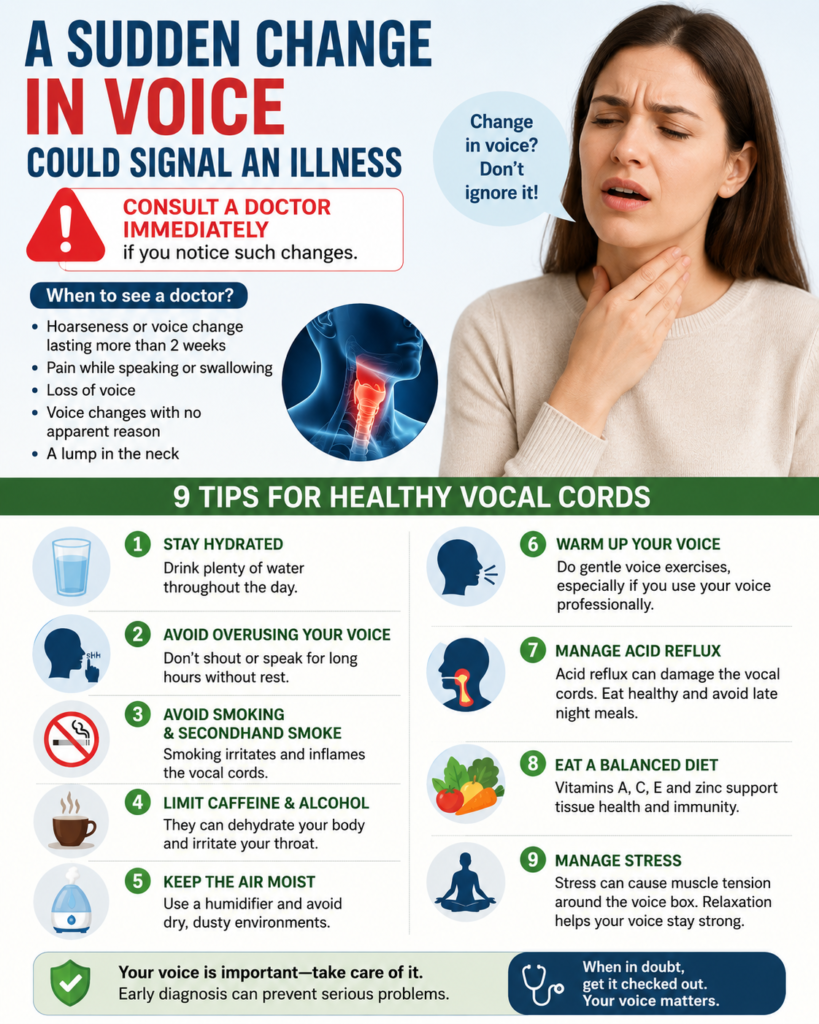
A sudden change in voice could signal an illness: consult a doctor immediately if you notice such changes; 9 tips for healthy vocal cords.
We often view the voice merely as a means of communication, yet it also serves as a crucial indicator of our health. While minor changes in the voice typically occur due to a cold or fatigue, alterations can sometimes signal underlying conditions such as diabetes, thyroid disorders, heart disease, or neurological issues.
In fact, the voice is produced through the coordination of the brain, lungs, and vocal cords; consequently, any disruption in these systems immediately affects the voice. This raises the question: which changes in the voice are normal, and which ones should not be ignored?
What kind of changes in the voice can be serious?
Which changes in the voice are signs of a medical condition?
Question: Which organs of the body does our voice depend on?
Answer: Voice production is a neuromuscular and respiratory process involving the coordinated action of several organs.
Brain: Acts as the control center for speech, issuing instructions to the respiratory system, muscles, and vocal apparatus.
Lungs: Generate airflow pressure, which serves as the primary source of energy for the voice.
Vocal cords (Larynx): Vibrate as air passes through them, producing sound.
Tongue, lips, and teeth: Shape the sound into distinct words—a process known as articulation.
Nose and throat: Determine the resonance, tone, and quality of the voice.
Question: Can a sudden change in voice indicate an underlying health condition?
Answer: A sudden change in voice can signal an internal issue. Our voice is linked to the brain, nerves, and respiratory system; therefore, the cause of such a change can sometimes be serious.
Question: What kind of voice changes are common?
Answer: Minor changes in the voice can occur due to the common cold, allergies, dehydration, or excessive talking.
Hoarseness: The voice sounds heavy or raspy.
Weak voice: The voice becomes faint or less clear.
Changes in pitch: The voice may become higher or lower.
Whispering or broken voice: The voice may break or falter while breathing.
Changes in speaking speed: It may vary between fast and slow.
Throat irritation or mucus: Mucus in the throat reduces vocal clarity.
Question: What kind of changes in the voice should be taken seriously, and why?
Answer: Certain changes can be early signs of a serious illness, so they should not be ignored. These symptoms could be linked to a stroke, a neurological disease, or cancer. It is essential to consult a doctor immediately in such cases.
Hoarseness lasting more than 2–3 weeks: A persistently deep or raspy voice could indicate a throat problem.
Sudden slurring of speech: Could be a sign of a stroke or a neurological issue.
Coughing up blood while speaking: May indicate a risk of serious throat or lung disease.
Weak or monotonous voice: Could signal a nerve or brain-related issue.
Difficulty breathing: Indicates a problem with the respiratory system.
Question: What are the possible reasons behind a sudden change in voice? What conditions could this indicate?
Answer: A sudden change in voice can signal various physical issues. Here is which type of voice change indicates which condition—
Question: Can diseases be diagnosed by identifying changes in the voice?
Answer: Yes, signs of certain diseases can be detected by analyzing changes in the voice. In recent years, there has been rapid research into voice analysis and AI techniques.
These techniques analyze voice pitch, speed, and vibration.
Vocal vibrations can provide indications of the risk of coronary artery disease.
Early symptoms of dementia and Parkinson’s can be identified through speech patterns. However, this serves only as a screening tool.
A definitive diagnosis of any disease is made only through clinical tests and a doctor’s consultation.
Question: Does one’s voice change due to mental health issues?
Answer: Yes, mental health has a direct impact on the voice. Emotions and stress alter the speed of brain functioning, which affects the tone and rhythm of the voice.
Depression: The voice becomes quiet, flat, and low-energy.
Anxiety: The voice may sound rapid, high-pitched, and shaky.
Chronic stress: Breathing quickens, causing the person to speak rapidly.
Schizophrenia: The voice may sound fragmented or monotonous.
If these changes persist for a long time, be sure to consult a mental health expert.
Question: What kind of vocal signs are associated with neurological conditions like Parkinson’s and Alzheimer’s?
Answer: Neurological diseases affect the brain and nerves, reducing control over the muscles required for speech.
Parkinson’s Disease: The voice becomes quiet, monotonous, and low-volume, with heavy breathing. A slight tremor in the vocal cords may also be observed. Vocal clarity decreases, and words are not articulated clearly.
Alzheimer’s/Dementia: Speech slows down, and the person pauses frequently. The brain struggles to find words, leading to shorter, simpler sentences. Repetition during conversation may increase.
Question: Is every change in the voice a sign of illness?
Answer: No, most changes are due to temporary causes and resolve with proper care.
Colds or allergies: Temporary hoarseness is common.
Dehydration: A dry throat can make the voice sound heavy or rough.
Excessive talking/shouting: Strain on the vocal cords alters the voice.
Caffeine or alcohol: These can dry out the throat and affect the voice.
Question: Is it natural for the voice to change with age? Answer: Yes, changes in the voice as one ages are normal. In medical terminology, this is known as ‘presbyphonia’.
Vocal strength may decrease.
A slight tremor may be felt.
The voice becomes quieter compared to before.
Speaking for extended periods causes fatigue.
This occurs due to a reduction in lung capacity.
Question: What tests are necessary if voice issues persist for more than 2–3 weeks?
Answer: This could indicate a serious underlying issue. Certain examinations by an ENT specialist are required to determine the exact cause.
Laryngoscopy: The structure and condition of the vocal cords are examined using a camera.
Video Stroboscopy: The vibration and functioning of the vocal cords are analyzed.
Blood Tests: Checks for thyroid or other hormonal imbalances.
Neurological Review: Conducted to detect issues related to the nerves or brain.
Pulmonary Tests: Conducted to assess the condition of the respiratory system.
Question: What can be done to keep the voice and vocal cords healthy?
Answer: Vocal cord health depends on daily lifestyle habits; proper care can help prevent problems.
Question: What symptoms accompanying a change in voice make it necessary to consult a doctor?
Answer: A mild sore throat or hoarseness usually resolves on its own within a few days. However, if these changes persist or are accompanied by other symptoms, it is important to consult a doctor. Examples include:
Hoarseness lasting more than 2–3 weeks.
Coughing up blood.
Pain or difficulty swallowing.
Difficulty breathing.
Sudden slurring of speech.
A very weak or monotonous voice.