
Sunburn Increases Skin Cancer Risk: Keep Your Skin Healthy—Do Not Ignore These 7 Signs; 10 Tips for Preventing Sunburn
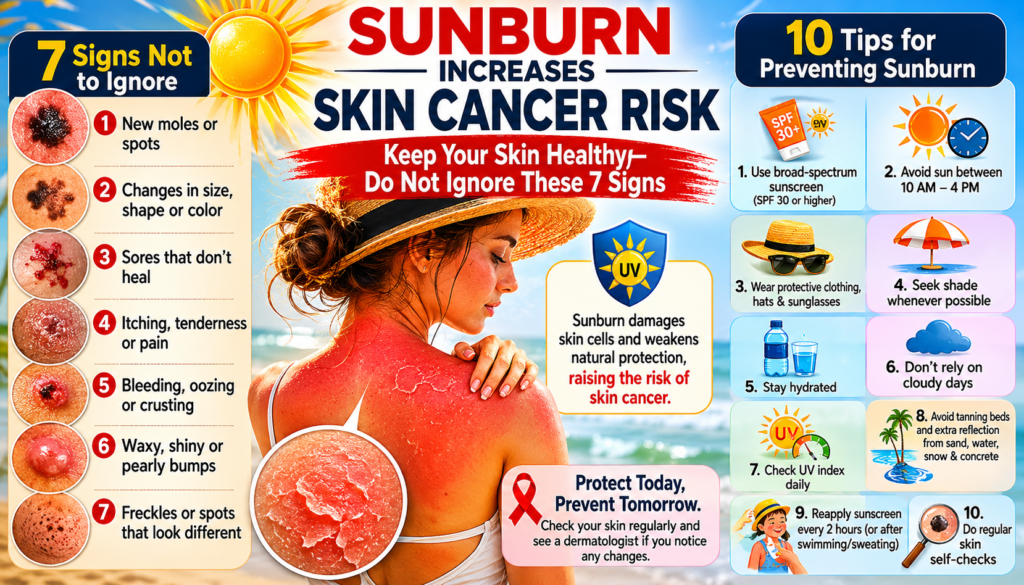
The scorching heat of summer damages not only the body but also the skin. This can lead to sensations of burning, redness, or stinging on the skin. These may be symptoms of sunburn.
People often overlook this, whereas, in reality, the sun’s UV (ultraviolet) rays damage the outermost layer of the skin.
Prolonged exposure to these rays can increase the risk of wrinkles, pigmentation, and even skin cancer.
According to the World Health Organization (WHO), excessive UV exposure can cause severe damage to the skin—particularly if one remains in the sun for extended periods without any protection.
How long does it take to get a sunburn from sun exposure?
How does sunburn damage the skin?
Question: What is a sunburn, and how does it occur?
Answer: When prolonged exposure to sunlight causes irritation and redness of the skin, it is referred to as a sunburn. Let’s understand this through the following points:
When the intense UV rays of the sun strike the skin, they damage the DNA contained within the skin cells.
The body possesses a kind of “alarm system”; when cells sustain damage, they emit signals (chemical messages) indicating that something is amiss.
In response to these signals, the body’s immune system becomes activated and increases blood flow to the affected area in order to facilitate the repair of the damage.
This is why the skin appears red, feels hot, and looks swollen; it also results in sensations of burning and pain.
Question: How long does one need to stay in the sun to get a sunburn?
Answer: This depends on the intensity of the sunlight, the duration of exposure, and one’s skin type. Consider the following points:
Fair or sensitive skin can begin to sunburn after just 10–20 minutes of exposure to strong sunlight.
Wheatish or dusky skin may develop a sunburn after 20–40 minutes of direct sun exposure.
The risk of sunburn is highest when spending time in the sun between 10:00 AM and 4:00 PM.
In hilly or mountainous regions, even brief exposure to sunlight can burn the skin.
Sunlight has a more rapid effect when near water or snow.
Going outdoors without sunscreen can lead to sunburn even while performing routine daily activities.
Question: Does sunburn only occur during the summer?
Answer: No, that is not the case. Sunburn can occur whenever the skin is exposed to the sun’s ultraviolet (UV) rays for an extended period.
Question: Can one still get a sunburn even if it is cloudy and the sun is not visible?
Answer: Yes, clouds do not completely block UV rays. Even on cloudy days, approximately 70–80% of UV rays can still reach the skin and cause damage.
Question: What is the difference between sunburn and tanning?
Answer: Both conditions result from the effects of UV rays, but there is a distinct difference between the two. Consider the following points:
In the case of sunburn, the skin turns red. The associated inflammation can be painful.
In the case of tanning, the skin darkens in color. This occurs as the body attempts to protect itself from UV rays by producing more melanin (melanin is the body’s natural pigment; it determines the color of the skin, hair, and eyes).
Question: How does sunburn damage the skin?
Answer: Sunburn occurs when the sun’s intense UV rays damage the cells in the outermost layer of the skin. Understand it through these key points:
It triggers an inflammatory response within the body.
It causes the skin to become red, warm to the touch, and painful.
In cases of severe damage, the body begins to shed the dead skin cells; consequently, the skin starts to peel after a few days.
Recurrent sunburns can cause the skin to age prematurely and may also increase the risk of skin cancer.
Question: What are the early signs of a sunburn?
Answer: A sunburn causes a burning sensation in the skin. The symptoms depend on the severity of the sunburn. Typically, a sunburn manifests through a specific set of symptoms.
Question: How long after sun exposure does skin redness and pain typically begin to appear?
Answer: Generally, redness and a burning sensation in the skin begin to manifest within 2 to 6 hours of spending excessive time in the sun. Symptoms may become more pronounced within 12 to 24 hours.
Question: Can sunburn also cause symptoms such as fever, headache, or nausea?
Answer: Yes; if a sunburn is severe, its effects are not limited solely to the skin. As the body’s inflammatory response intensifies, symptoms such as fever, headache, fatigue, and nausea may also occur.
Question: When is it necessary to consult a dermatologist for a sunburn?
Answer: Certain symptoms of a sunburn can be severe. Refer to the following points to determine when it is necessary to see a dermatologist:
Large blisters form on the skin.
There is intense pain.
A fever of 101°F or higher develops.
You experience dizziness or confusion.
If the sunburn covers a large portion of the body, consult a dermatologist immediately. It is particularly important for children, the elderly, or individuals with compromised immune systems to seek medical advice as soon as symptoms appear.
Question: How long does it take for a sunburn to heal?
Answer: A mild sunburn typically heals within 3 to 5 days. If the sunburn is severe, recovery may take up to 7 to 10 days.
Question: Does getting a sunburn increase the risk of skin cancer?
Answer: Yes, UV rays damage the DNA within skin cells. If this occurs over a prolonged period or repeatedly, the risk of developing skin cancer may increase.
Question: Who is at a higher risk of developing skin cancer?
Answer: Anyone can develop skin cancer. However, certain conditions can increase the risk.
Question: How much time is it safe to spend in the sun?
Answer: Spending 15–30 minutes in the mild morning sun is generally considered safe.
Sunlight before 8:00 AM or after 5:00 PM is the safest.
During these times, the body receives Vitamin D without causing damage to the skin.
If your skin begins to turn red or you feel a burning sensation, it indicates that you have had excessive sun exposure.
Question: What should be done to get immediate relief from a sunburn?
Answer: Consider the following points:
Immediately cool down the affected area. This helps reduce swelling and pain.
Take a cool shower or bath.
Apply a cold compress to the affected area for 15–20 minutes, 2–3 times a day.
Avoid swimming in chlorinated pools, as this can irritate the affected skin.
Do not use soaps or scented products, as they may aggravate the irritation.
Question: Are there any home remedies for sunburns? Is applying Aloe Vera gel beneficial?
Answer: For mild sunburns, certain home remedies can provide relief. Among these, Aloe Vera gel is considered the most beneficial. Aloe Vera is also known as the “burn plant.” It helps reduce skin irritation, swelling, and redness. It provides a cooling sensation to the skin and accelerates the healing process.
Question: Are home remedies such as applying yogurt or gram flour (besan) safe and effective for sunburns?
Answer: Applying cool yogurt to a sunburn can provide some degree of relief. The cooling effect of yogurt—along with its fat content and lactic acid—can help retain moisture in the skin and aid in the healing process. However, gram flour (besan) should be used with caution. While gram flour is commonly used to remove sun tans, it can actually increase irritation on sensitive and damaged skin affected by sunburn.
Question: What steps should be taken to prevent sunburns?
Answer: Intense sunlight can cause damage to the skin in just a few minutes. Therefore, it is essential to prepare before stepping out to prevent sunburn.
Question: Can sunscreen reduce the risk of sunburn?
Answer: Yes, sunscreen can significantly reduce the risk of sunburn. It helps protect the skin from UVA and UVB rays. UVB rays are the primary cause of sunburn. Broad-spectrum sunscreen protects the skin from damage by blocking or absorbing these harmful rays.
However, simply applying sunscreen is not sufficient. It is also essential to apply it in the correct amount, reapply it every 2–3 hours, and exercise extra caution during periods of intense sunlight.
Question: What kind of lifestyle should one adopt to reduce the risk of skin cancer?
Answer: The risk of skin cancer is linked not only to sun exposure but also to our daily habits. This risk can be significantly reduced by practicing sun safety, maintaining a balanced diet, and adopting a healthy lifestyle.
People often dismiss sunburn as merely a temporary skin issue, whereas it can cause long-term damage to the skin. If sunburn occurs repeatedly or the symptoms are severe, one should consult a dermatologist.