
Go to bed and wake up at the same time every day: Irregular sleep increases the risk of 172 diseases—largest study on sleep to date.
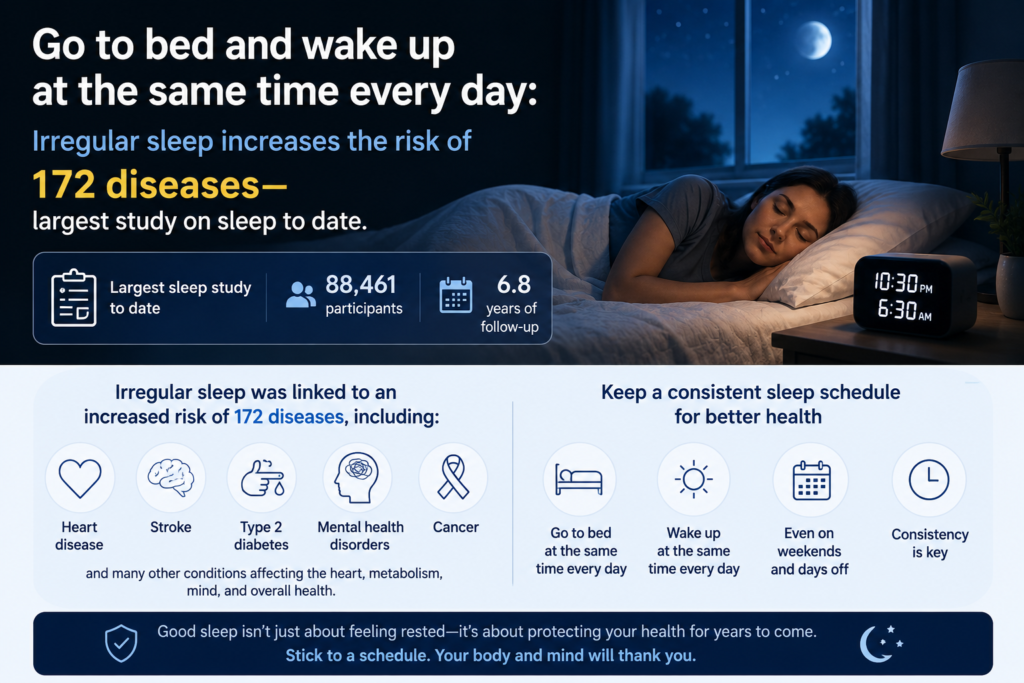
According to a study published in the science journal Health Data Science, going to bed at different times each day is just as harmful to the body as getting insufficient sleep. This study, conducted over a period of approximately seven years, revealed a strong link between sleep patterns and various diseases.
In this study involving 88,461 participants, sleep patterns were tracked using wearable devices. A wearable device is an electronic gadget—similar to a smartwatch—that monitors total sleep duration, bedtimes and wake-up times, heart rate, and other bodily activities.
The health study found that going to bed at varying times, staying up late, and having an irregular body clock increase the risk of developing 172 different diseases.
Which diseases does a disrupted sleep pattern increase the risk of?
How can the sleep cycle be fixed?
Question: What does the new sleep study published in ‘Health Data Science’ reveal? Why is it being hailed as the most authentic sleep study to date?
Answer: The study reveals a direct link between sleep patterns and diseases.
It is considered the most authentic study so far because most previous studies relied on subjective sleep measurements—meaning they depended on people self-reporting how much they slept.
In contrast, this study utilized objective measurements—specifically, data tracked via wearable devices—which are far more accurate.
Furthermore, the study is based on a massive database like the UK Biobank and has been validated using data from the National Health and Nutrition Examination Survey (NHANES).
Question: By how much does the risk of various diseases increase due to irregular, insufficient, and poor-quality sleep?
Answer: Studies have found that irregular sleep (going to bed at different times each day), sleeping less than 6 hours, poor sleep quality (frequent waking during the night), or low sleep efficiency increases the risk of numerous diseases.
The risk of a total of 172 diseases increases, with 92 of these being directly affected by sleep.
Insufficient sleep increases the risk of heart disease, diabetes, and obesity by 1.5 to 2 times.
Poor sleep leads to increased inflammation, which can raise the risk of liver cirrhosis by up to 2.57 times.
Question: The liver, kidneys, and heart are vital organs. Poor-quality sleep damages them. Does this mean that poor sleep is a life-threatening condition?
Answer: Yes, poor-quality sleep can indeed be life-threatening. Studies have shown that poor sleep increases inflammation, which impairs the filtering and functioning of these organs.
This condition is life-threatening because the problems escalate gradually. Initially, it manifests as fatigue, but in the long run, it can lead to organ failure. Remember, sleep is not merely about rest; it is the body’s repair process. Ignoring it is akin to putting your life at risk.
Question: What does “irregular sleep” mean in this study, and how does it differ from getting insufficient sleep?
Answer: In the study, irregular sleep refers to a disruption of the sleep rhythm. Essentially, going to bed and waking up at different times each day disturbs the body clock. The body clock operates on a 24-hour circadian rhythm. If you go to sleep at 10 PM one day and at 1 AM the next, the body doesn’t know when to switch into “rest mode.”
Insufficient sleep simply means a lack of total sleep hours—for instance, sleeping only five hours a day. With irregular sleep, however, you might still get the required number of hours, but the timing is inconsistent.
While insufficient sleep increases the risk of diabetes or obesity, irregular sleep is more strongly linked to inflammation and neurological issues. Both are detrimental, but irregular sleep has a greater impact on the body’s internal systems.
Question: Is the habit of irregular sleep more dangerous than getting insufficient sleep?
Answer: Yes, according to the study, irregular sleep can be more dangerous than insufficient sleep because it directly affects the body’s circadian rhythm. If you get too little sleep, the body becomes fatigued, but that fatigue can often be recovered by sleeping longer the next day.
In contrast, irregular sleep leads to persistent imbalances in hormones, immunity, and metabolism. The study found that 83 out of 172 diseases were “sleep-rhythm specific”—meaning they were directly linked to irregular sleep. The risk of conditions like liver cirrhosis or gangrene increases significantly with irregular sleep timing. While insufficient sleep might raise the risk by 1.5 to 2 times, irregular sleep can increase it by 2.5 to 3.36 times. Therefore, going to bed at the same time every day is crucial.
Question: What effect does delaying bedtime by 30–60 minutes have on the body?
Answer: If your bedtime is delayed by 30–60 minutes daily, your body clock shifts. A study found that going to bed after 12:30 AM increases the risk of liver fibrosis by 2.57 times. This disrupts the production of the hormone melatonin, which regulates sleep and immunity.
It leads to increased inflammation in the body, an unstable heart rate, and fatigue the following day. In the long run, it can increase the risk of diabetes, obesity, and mental stress.
Question: Does irregular sleep affect mental health as well?
Answer: Absolutely; irregular sleep has a profound impact on mental health. Studies have shown that irregular sleep increases anxiety, stress, and neurological issues.
The risk of Parkinson’s disease can rise by up to 37%. Poor sleep imbalances brain chemicals like serotonin, which negatively affects mood. Going to bed at different times each day reduces focus, increases irritability, and raises the risk of depression. It affects both physical and mental health.
Question: Can going to bed at the same time every day reduce the risk of diseases?
Answer: Yes, it strengthens the circadian rhythm, which can significantly lower the risk of 172 different diseases.
Studies have revealed that having a fixed bedtime reduces the risk of gangrene, and regular sleep helps minimize liver problems. It helps control inflammation, boosts immunity, and keeps organs healthy. These are simple changes that prove beneficial in the long run.
Question: What can be done to improve sleep patterns? How can one fix their sleep cycle?
Answer: Improving sleep patterns is easy; it simply requires a bit of discipline. First, establish a routine of going to bed and waking up at the same time every day—for instance, sleeping at 10 PM and waking up at 6 AM. Avoid sleeping too much during the day; take a nap of only 20–30 minutes, and only if necessary. Avoid caffeine or heavy meals in the evening. Limit screen time, as blue light blocks melatonin (a hormone essential for sleep).
Keep these tips in mind for a good night’s sleep:
Keep the bedroom dark, cool, and quiet.
Exercise daily.
If you cannot sleep, try deep breathing or meditation.
Track your sleep routine using a wearable device.
Consult a doctor if the problem is severe.
You can seek help from CBT (Cognitive Behavioral Therapy) if needed.
Gradually, this will become a habit, and your body clock will adjust itself.
Been playing at online casinos for years and finally found a site that feels trustworthy from day one. The withdrawals are quick and the promotions actually match what they advertise. It is rare to see this level of care for regular players so I am giving it five stars. Drop by and see why gt88casino keeps me coming back every weekend.