
Ebola Virus Declared a Global Health Emergency: Are You at Risk? Get Answers to All Your Questions from a Doctor.
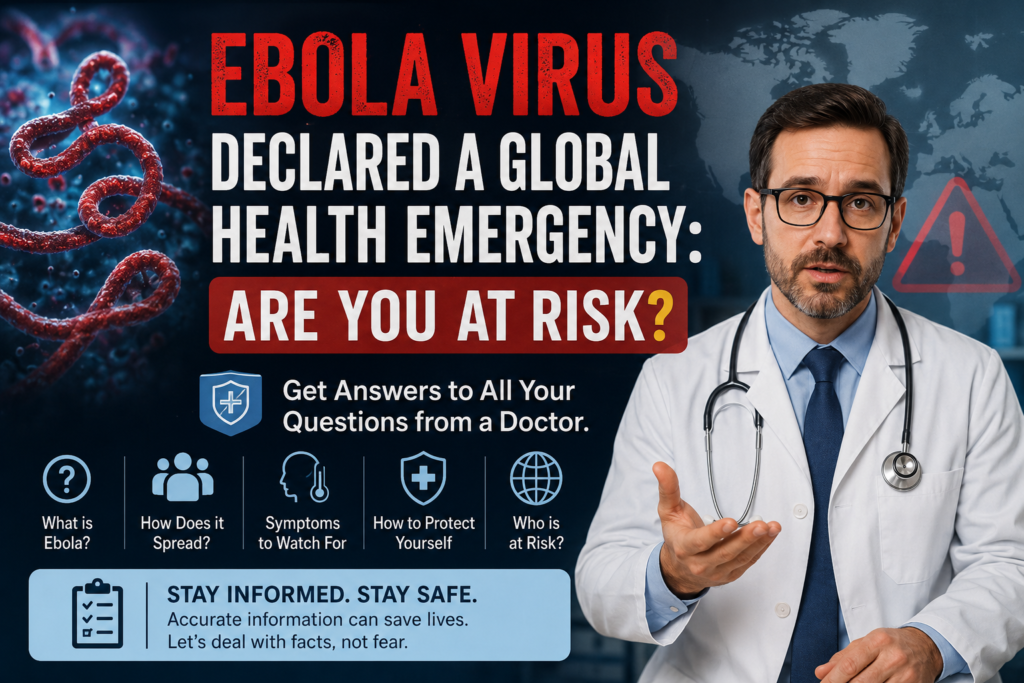
The World Health Organization (WHO) has declared the Ebola virus a ‘Global Health Emergency.’ Travelers visiting Congo, Uganda, and Sudan have been specifically advised to exercise caution. The directive calls for heightened surveillance at all international entry points, border areas, and airports. Additionally, travelers have been advised to avoid non-essential travel to Ebola-affected countries.
Therefore, in today’s ‘Physical Health’ column, we will discuss the Ebola virus. We will also explore:
How dangerous is the Ebola virus?
How does the infection spread?
What are the preventive measures against it?
Question: Why has the WHO declared Ebola a ‘Global Health Emergency’?
Answer: The number of people infected with the Ebola virus worldwide has reached 900. Consequently, 200 people have died in the Congo over the past 20 days. The ‘Bundibugyo’ variant of the Ebola virus is spreading rapidly. Therefore, the WHO has declared it a Global Health Emergency.
Question: Which countries have the highest number of Ebola cases?
Answer: To date, cases of Ebola have been recorded in 10 African countries. These include:
Republic of the Congo
Angola
Burundi
Central African Republic
Ethiopia
Kenya
Rwanda
South Sudan
Tanzania
Zambia
Travel to Congo (DRC), Uganda, and South Sudan is advised against unless essential, due to the risk of Ebola infection in these regions.
Instructions have been issued to heighten surveillance at airports and other points of entry, and to screen travelers arriving from affected areas.
Emphasis has been placed on ensuring the identification, screening, reporting, and appropriate management of travelers presenting with unexplained fever.
In accordance with WHO recommendations, travelers are advised to exercise caution and minimize travel to affected regions.
Question: What is the Ebola virus? How dangerous is it?
Answer: Ebola is a severe and highly contagious viral ‘hemorrhagic fever.’ It is caused by infection with the Ebola virus. It affects humans and certain wild animals (such as bats and primates).
How dangerous is it?
The mortality rate in cases of Ebola is extremely high. Therefore, it is considered one of the world’s deadliest infectious diseases.
Question: How does Ebola virus infection spread?
Answer: The infection spreads through the following means:
Through direct contact with the blood, saliva, sweat, vomit, urine, feces, or other bodily fluids of an infected person.
By touching the clothes, bedding, needles, medical equipment, or other contaminated objects belonging to an infected person.
Through contact with infected wild animals—particularly fruit bats, monkeys, and other primates.
Through contact without proper protective measures while caring for an infected patient or during funeral rites.
Question: Can Ebola spread through the air (be airborne)?
Answer: Generally, Ebola does not spread through the air. It spreads through direct contact with the bodily fluids of an infected person.
Question: What are the early symptoms of Ebola? Which signs should not be ignored?
Answer: The early symptoms of Ebola resemble those of a common viral fever. Therefore, early detection is crucial.
Question: What is the treatment for Ebola?
Answer: Currently, there is no approved vaccine or specific treatment available for the ‘Bundibugyo’ variant of Ebola that is currently spreading.
Question: Who is at higher risk of Ebola infection?
Answer: The following groups are at higher risk of Ebola infection:
Question: Is Ebola fatal?
Answer: Yes, Ebola is a serious and life-threatening disease.
Question: What is the mortality rate for Ebola?
Answer: In Ebola outbreaks, the mortality rate has been recorded to range from approximately 25% to 90%.
Question: Is a vaccine available for the Ebola virus?
Answer: Several vaccines have previously been developed for the Ebola virus; however, no vaccine is currently available for the Bundibugyo variant (which is currently spreading).
Question: What precautions should be taken while traveling abroad?
Answer: If you are planning to travel abroad to a region where an Ebola outbreak is currently active, the following precautions should be observed:
Question: How effective are sanitization and masks in protecting against Ebola?
Answer: Regular hand hygiene reduces the risk of infection.
Sanitizers are helpful in cleaning hands that may be contaminated with the virus.
Masks reduce the risk of contact with fluids from an infected person.
Masks alone are not sufficient; other precautions are also necessary.
For healthcare workers, PPE kits provide the most effective protection.
Question: What should a person do if they—or someone they know—has recently traveled to Uganda, Congo, Sudan, or any other Ebola-affected country?
Answer: Observe your health closely for 21 days.
Consult a doctor immediately if you experience fever, weakness, vomiting, or diarrhea.
Disclose your travel details to healthcare professionals.
Maintain a distance from others if symptoms appear.
Follow the guidelines issued by the local health department.