
Not all allergies are minor—they can be fatal; learn from a doctor what anaphylaxis is, and if you have an allergy, keep this injection with you.
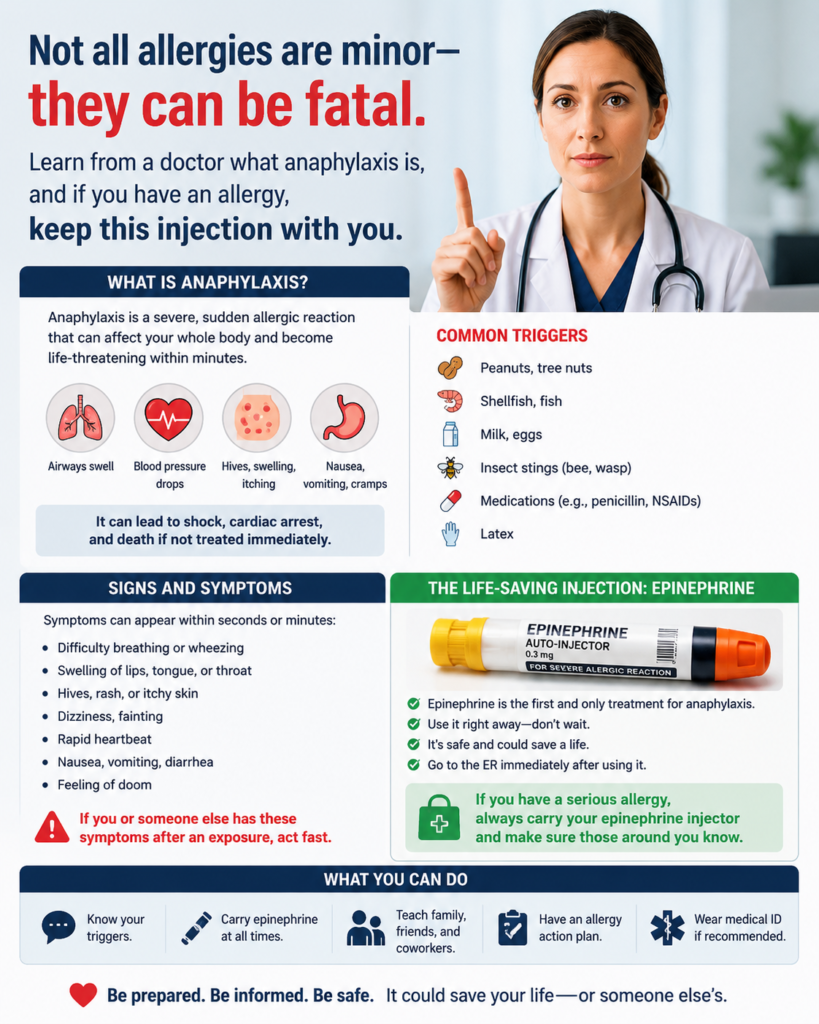
According to the National Institutes of Health, approximately 20–30% of people worldwide experience allergies at some point in their lives. Symptoms typically include sneezing, itching, or watery eyes. However, in some individuals, these allergies can suddenly trigger anaphylaxis.
Anaphylaxis is a severe allergic reaction. It can cause a sudden drop in blood pressure and, in some cases, lead to organ failure.
According to a study published in The Journal of Allergy and Clinical Immunology, 1 to 5 out of every 100 people in the United States have experienced anaphylaxis at some point.
How does it affect the body?
How can anaphylaxis be prevented?
Question: What is anaphylaxis?
Answer: Understand it through the points below–
Anaphylaxis is a type of allergy, but it is a more severe form.
It can be triggered by certain food items, medications, or insect stings.
It involves a very rapid reaction within the body.
In cases of anaphylaxis, the condition can become critical within just a few minutes.
It is a medical emergency; therefore, immediate treatment is required.
Question: How is it different from a common allergy?
Answer: The major difference between a common allergy and anaphylaxis lies in the severity of the symptoms. Understand this through the following points:
Common Allergy
It presents mild symptoms such as sneezing, itching, watery eyes, or skin rashes.
Symptoms are often confined to a specific part of the body.
It is usually not life-threatening.
Anaphylaxis
The reaction escalates rapidly and can affect multiple body organs simultaneously.
It can lead to issues such as respiratory problems, throat swelling, low blood pressure, and loss of consciousness.
Anaphylaxis can be life-threatening.
Question: What happens in the body during anaphylaxis?
Answer: During anaphylaxis, the immune system suddenly overreacts. Here is how it works:
The body perceives even a harmless substance as a major threat.
In response, the immune system releases certain chemicals; histamine is the most significant among them.
The effect of histamine causes blood vessels to relax and dilate (widen).
This leads to a sudden drop in blood pressure, reducing blood supply to vital organs.
Immediate effects may be visible on the skin, such as itching, redness, and rashes. Swelling may occur in the face, lips, and tongue.
Question: How quickly does anaphylaxis develop?
Answer: Symptoms begin within 5–30 minutes and can become severe within just a few minutes.
Question: Can any allergy progress to anaphylaxis?
Answer: No, that does not happen in every case. However, in some people, an allergic reaction can escalate into anaphylaxis. Therefore, allergy symptoms should not be ignored. Seek immediate medical help if an allergic reaction is accompanied by:
Difficulty breathing
Swelling of the face or throat
Dizziness
Fainting
Question: What can trigger anaphylaxis?
Answer: Anaphylaxis is usually triggered by substances to which the body is allergic. These triggers vary from person to person, but there are some common causes.
Question: Can everyday foods also act as triggers?
Answer: Yes, it depends on what the person is allergic to. For some people—
Milk
Eggs
Peanuts
Tree nuts
Common food items like wheat, soy, or seafood can also prove dangerous.
What is generally considered safe can become risky for someone with an allergy.
Question: Can medications also cause anaphylaxis?
Answer: Yes, certain medications can trigger anaphylaxis. The highest risk comes from specific antibiotics, such as—
Penicillin-group drugs.
Painkillers.
Some people may also experience a reaction to vaccines or anesthesia. Therefore, always inform your doctor if you have previously had an allergic reaction to any medication.
Question: Can this happen to anyone?
Answer: Yes, anaphylaxis can affect anyone. However, the risk is higher for those who already have—
Food allergies.
Drug allergies.
Asthma.
In some cases, a severe reaction can occur even in a person who has never had an allergy before.
Question: When can anaphylaxis be life-threatening?
Answer: Anaphylaxis can be life-threatening in the following situations:
When severe breathing difficulties arise.
When there is significant swelling in the throat and windpipe, causing the airway to narrow.
When the body begins to experience a lack of oxygen.
When blood pressure drops suddenly and drastically.
When adequate blood fails to reach the brain, heart, and other organs.
When the person feels dizzy or loses consciousness.
When there is a delay in receiving treatment.
When the patient goes into ‘anaphylactic shock,’ which is a medical emergency.
Question: How is anaphylaxis diagnosed?
Answer: Diagnosis is primarily based on symptoms and timing.
Doctors observe how quickly the reaction occurs after exposure to an allergen.
Anaphylaxis may be suspected if symptoms affecting the skin, breathing, and heart appear simultaneously within a timeframe ranging from a few minutes to an hour.
A sudden drop in blood pressure is also a crucial indicator, signaling a severe reaction.
Question: What is the treatment for anaphylaxis?
Answer: See the points below:
The primary and most critical treatment for anaphylaxis is an epinephrine (adrenaline) injection.
Doctors may advise individuals at risk of severe allergies to carry an epinephrine auto-injector.
The injection is administered into the thigh muscle as soon as symptoms of a severe allergic reaction appear.
The medication acts rapidly, helping to control symptoms such as breathing difficulties, swelling, and low blood pressure.
Emergency medical assistance is essential immediately after the injection is administered; the patient must be taken to the hospital right away.
Medical monitoring is required for some time even after treatment, as symptoms can recur in certain cases.
Epinephrine (adrenaline) injections should not be used without a doctor’s advice. Keep this with you only if a doctor has prescribed it.
Question: Is home treatment for anaphylaxis possible?
Answer: No, there is no home treatment for anaphylaxis. It is a medical emergency. Delay can be dangerous.
Anaphylaxis is a life-threatening allergic condition. A little awareness and preparation can significantly reduce the risk associated with this serious condition.