
Holding Urine Is Dangerous for Women: Severe Bladder Damage, Increased Risk of Infection, and 11 Tips for Toilet Hygiene
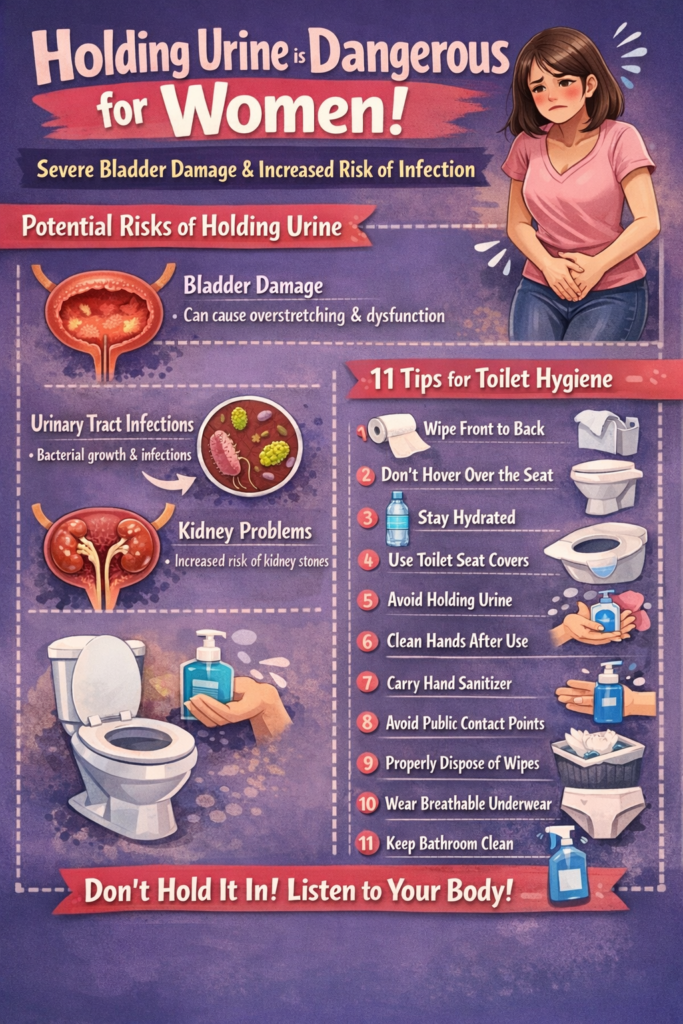
Women often hold their urine for extended periods due to busy work schedules, traffic, or a fear of using unsanitary public restrooms. Doing this repeatedly can be detrimental to one’s health.
Holding urine for prolonged durations places excessive pressure on the bladder, impairs its functionality, and increases the risk of Urinary Tract Infections (UTIs). It can also lead to muscle weakening and kidney-related complications. Given these risks, it is crucial for women to practice proper toilet hygiene.
What damage does holding urine cause to the bladder?
What health risks are associated with this practice?
How long is it safe to hold one’s urine?
Question: What happens to the body when a woman holds her urine for an extended period?
Answer: Holding urine for a prolonged duration places excessive pressure on the bladder. This can lead to various health problems, such as:
The bladder muscles may become weak or overstretched.
The risk of developing a Urinary Tract Infection (UTI) increases.
It may cause pain in the lower abdomen and a frequent urge to urinate.
Question: What harm does holding urine for extended periods cause to the bladder?
Answer: When the bladder remains full for a prolonged duration, it exerts constant pressure on its muscles and inner lining. This increases the risk of infections and other complications.
Urinary Tract Infection (UTI)
When urine remains in the bladder for extended periods, bacteria begin to multiply.
This increases the risk of developing a Urinary Tract Infection (UTI).
Pressure on the Bladder
Repeatedly over-stretching the bladder can cause its muscles to weaken.
Over time, this may lead to difficulties in controlling urination or problems with urinary ‘leakage.’
Impact on the Kidneys
Holding toilet for too long can cause pressure to build up and backflow upwards.
This increases the risk of kidney infections.
In the long run, this can negatively affect kidney function.
Bladder Stones
When urine remains stagnant for prolonged periods, mineral crystals can form, increasing the risk of developing stones.
This can lead to health issues such as pain, blood in the urine, or intermittent urination.
Pelvic Floor Damage
Repeatedly holding urine can disrupt the natural rhythm of the pelvic muscles.
Over time, this may result in problems with bladder control.
Pain and Discomfort
One may experience a sensation of heaviness or pain in the lower abdomen.
Occasionally, this may manifest as sudden, intense pain accompanied by an involuntary leakage of urine.
Question: Can holding urine for extended periods cause kidney damage?
Answer: Yes, it can lead to several kidney-related conditions, such as:
Hydronephrosis: This is a condition characterized by swelling of the kidney. Essentially, urine is unable to drain properly and begins to accumulate within the kidney itself.
Pyelonephritis: This is a serious bacterial infection of the kidney that typically originates as a UTI and then spreads upward to reach the kidney.
Question: Can holding urine be particularly dangerous during pregnancy? Answer: Yes, this increases the risk of a Urinary Tract Infection (UTI). If this infection spreads to the kidneys, it can even lead to premature delivery.
Question: How long is it safe to hold one’s urine?
Answer: This depends on the individual’s age, the amount of water or fluids consumed, and their overall health condition.
According to the ‘National Library of Medicine,’ it is generally considered best to pass urine every 3 to 4 hours. However, it is advisable to go immediately as soon as the urge to urinate is felt.
Question: Does frequently holding urine permanently reduce bladder capacity?
Answer: Holding urine occasionally does not permanently reduce bladder capacity. However, doing so continuously over a prolonged period can impair bladder function. This increases the risk of infections or other urinary complications.
Question: Should everyone generally follow specific toilet hygiene practices? What does this entail, and what steps are involved?
Answer: People often overlook minor hygiene details due to haste or carelessness. This increases the risk of infection. However, adhering to certain basic toilet hygiene practices can help prevent various diseases.
By adopting these simple habits, the risk of urinary tract infections and other related issues can be minimized.
Question: Does sitting in the same spot for extended periods also affect bladder health?
Answer: Yes, it has a negative impact on the bladder. Consider the following points:
Sitting in one place for prolonged periods reduces blood flow to the pelvic area.
This weakens the pelvic floor muscles, which provide support to the bladder and the urethra (the passage through which urine exits the body).
Sitting stationary for long durations also slows down metabolism. This, in turn, increases the risk of developing kidney stones.
Question: Apart from holding one’s urine, what other daily habits of ours can affect bladder health?
Answer: A poor lifestyle, dehydration, chronic diseases, and poor hygiene can all place additional strain on the bladder.