Food Spoils Quickly in Summer: 24 Food Storage Tips to Keep Food Safe—Avoid These 10 Mistakes While Storing.
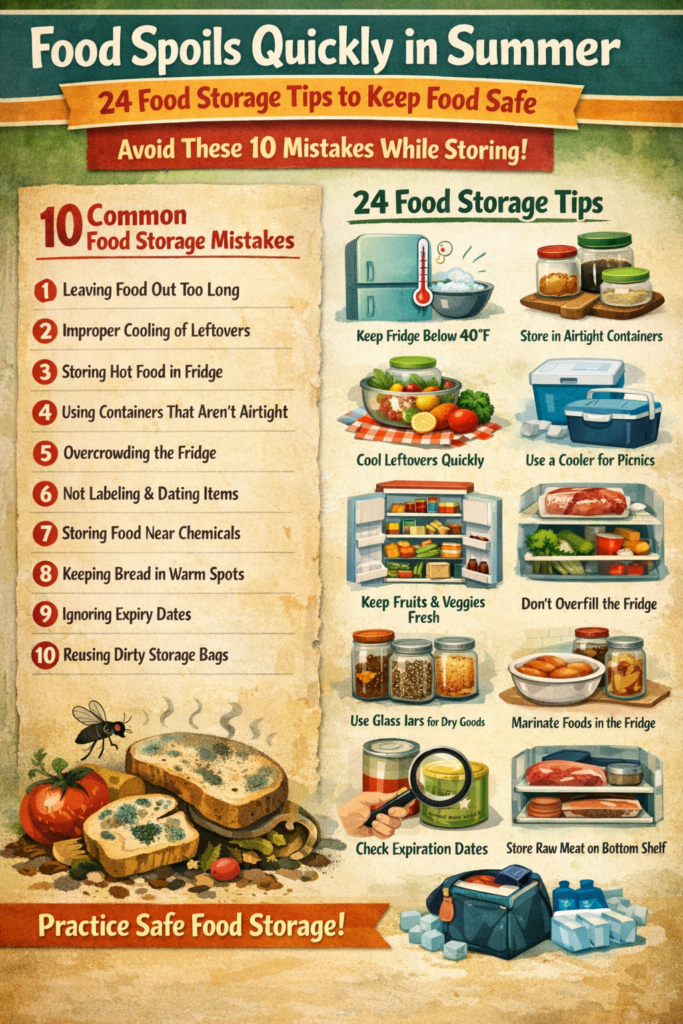
Food items tend to spoil quickly during the summer season. Overlooking minor mistakes in food storage can lead to food poisoning, diarrhea, and various stomach-related ailments.
In this context, proper food storage serves as a crucial component of disease prevention.
What are the basic rules for food storage during the summer?
Which mistakes should be avoided?
How should different food items be stored?
Question: Why is proper storage of food and beverages essential during the summer?
Answer: During the summer, elevated temperatures accelerate bacterial growth. This can lead to the formation of toxins in food. Proper storage methods—such as freezing or using airtight containers—can slow down or halt bacterial proliferation, thereby keeping the food safe.
Question: Why does food spoil more quickly during the summer?
Answer: Several factors are responsible for this:
High temperatures accelerate bacterial growth.
In hot weather, the fats present in food begin to oxidize rapidly, causing oily foods to develop an unpleasant odor.
High temperatures accelerate the breakdown of proteins. This process occurs particularly quickly in protein-rich foods—such as milk, lentils, and meat—leading to changes in their smell.
Summer brings higher humidity levels, which creates an environment where fungi and yeast thrive rapidly on items such as cooked meals, bread, and fruits.
Frequent fluctuations in temperature—such as leaving food out at room temperature and then placing it in the refrigerator—cause food to spoil more quickly.
Question: What are the basic rules for food storage during the summer?
Answer: It is essential to follow certain basic storage guidelines during the summer to ensure that food remains safe, fresh, and healthy.
Question: What mistakes should be avoided when storing food during the summer?
Answer: Small, inadvertent errors can cause food to spoil rapidly during the summer months.
Question: What health problems can arise from improper food storage during the summer?
Answer: Even minor negligence can lead to health issues ranging from food poisoning to stomach infections.
Question: How can one tell if a food item has gone bad?
Answer: It’s not rocket science. Typically, the smell and texture of food indicate whether it has spoiled. However—
During the summer season, do not rely solely on smell, color, or texture.
If the temperature exceeds 40 degrees Celsius and the food has been left out for more than three hours, do not consume it.
If the food tastes even slightly off, do not eat it.
Question: What is the correct way to store different foods in the summer?
Answer: Read the detailed storage methods for each type of food item below.
Vegetables
First wash and dry green leafy vegetables thoroughly. Then wrap them in a paper towel and store them in the refrigerator.
Store chopped vegetables in an airtight container in the refrigerator. Use within 24 hours.
Do not store root vegetables like potatoes, onions, and garlic in the refrigerator. Store them in a cool, dry place.
Fruits
Eat chopped fruit immediately or store them in an airtight container in the refrigerator.
Fruits like grapes and berries should be washed and thoroughly dried before storing them in the refrigerator.
Cooked Food
Refrigerate cooked food within 2 hours.
Refrigerate only after it has cooled to room temperature.
It is best to consume it within 1-2 days.
Milk
Boil and cool milk.
Store cold milk on the inner shelf of the refrigerator.
Yogurt
Always keep yogurt covered and refrigerated.
Use a clean spoon when removing the yogurt.
Non-Vegetarian Food
Do not store non-vegetarian food in the refrigerator for more than 1-2 days during the summer.
If storing it for a longer period, store it in the freezer.
Always store it in a separate airtight container to prevent cross-contamination with other foods.
Bread and Bakery Items
Store bread and bakery items in a dry place.
Freeze them if storing them for a longer period.
Dry Food
Store dry foods in airtight containers.
Keep snacks like namkeen and biscuits tightly sealed and away from moisture.
Drinks
Drink fresh juice immediately.
If storing, use it within 24 hours.
Always keep water covered.
Do not store water in plastic bottles for long periods.
Pickles and Sauces
Use a dry spoon to scoop out pickles.
Place them in direct sunlight occasionally.
It is best to store sauces in the refrigerator.
Chocolates and Sweets
Store chocolates in a cool, dry place.
Store sweets in the refrigerator.
Consume sweets within 2–3 days.
Question: What are the myths and facts regarding food storage during the summer?
Answer: During the summer, there are many common food storage practices that people accept as truth without verifying them. Therefore, it is essential to understand the distinction between what is correct and what is incorrect.
Myth 1: All fruits and vegetables stay fresh if kept in the refrigerator.
Fact: This is not true. Items such as potatoes, onions, garlic, and avocados can spoil more quickly if stored in the refrigerator. Keep them in a cool, dry place instead.
Myth 2: Leftover food remains safe to eat for several days if kept in the refrigerator.
Fact: Food spoils more rapidly during the summer. Cooked meals should be consumed within 24 to 48 hours. They should only be eaten after being thoroughly reheated.
Myth 3: The temperature is uniform throughout the entire refrigerator.
Fact: The upper shelves of the refrigerator have the lowest (coldest) temperature, whereas the door compartments are the least cold areas.
Myth 4: Bottled or canned products do not spoil.
Fact: Once opened, canned or bottled food items must be stored in the refrigerator. Leaving them out in the open can cause them to spoil quickly.
Some Common Questions and Answers Regarding Food Storage in Summer
Question: At what temperature should the refrigerator be set during the summer?
Answer: The refrigerator temperature should be maintained between 1–4°C, and the freezer at approximately -18°C.
Question: Is it safe to eat stale food after reheating it?
Answer: Yes, but only if it is no more than two days old. Do not reheat food more than once. Take out only as much food from the refrigerator as you intend to consume. If any reheated food remains uneaten, discard it. Question: Is it necessary to maintain hygiene when storing food?
Answer: Yes; bacteria spread rapidly from dirty hands, utensils, or refrigerators, which can cause food to spoil quickly.
Question: Is it safe to heat food in a microwave during the summer?
Answer: Yes, it is completely safe. However, ensure that the food is heated thoroughly and evenly.
Question: Can food stored in a refrigerator for an extended period be harmful?
Answer: If the refrigerator temperature is set to 3–4 degrees Celsius, raw items stored inside remain safe for up to one week. Cooked food remains safe for 3 to 4 days. However, during the summer, food items should not be kept in the refrigerator for excessively long periods.