12 Signs of Iron Deficiency: Do Not Ignore—It Could Lead to Anemia or Infections; Include Red Leafy Greens in Your Diet
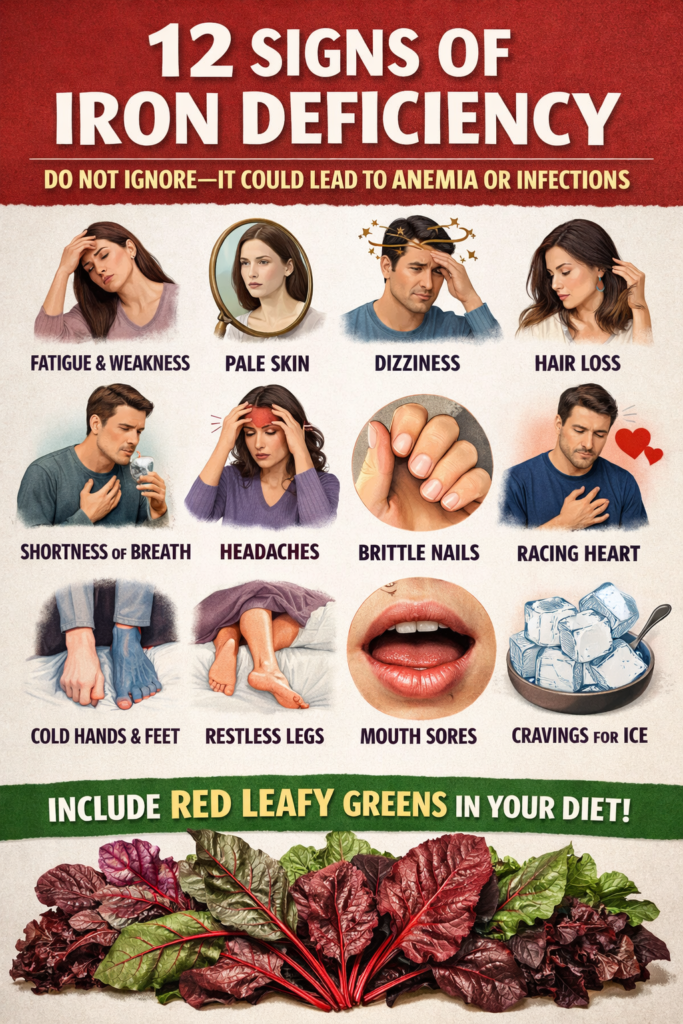
According to the National Family Health Survey 5 (NFHS-5), approximately 57–59% of women aged 15–49 in India suffer from anemia—that is, a deficiency of blood. The primary cause of anemia is iron deficiency. Iron is a critical (extremely essential) mineral for the body.
Iron deficiency gradually weakens the body. People often overlook its early signs, mistaking them for ordinary fatigue.
There are certain foods that can help protect against the risk of anemia. Red leafy greens are one such food; they are rich in iron.
What are red leafy greens, and what nutrients do they contain?
When should you consult a doctor in case of iron deficiency?
Question: What is iron, and what functions does it perform in the body?
Answer: Iron is an essential mineral that produces hemoglobin in the body. Approximately 70% of the body’s iron is stored in the blood in the form of hemoglobin.
Hemoglobin is a protein present in red blood cells (RBCs) that carries oxygen from the lungs and transports it throughout the entire body. A deficiency of iron in the blood leads to a reduction in oxygen supply. This can result in fatigue, weakness, and anemia. What essential functions does iron perform in the body?
Question: What is the difference between plant-based iron and animal-based iron?
Answer: Plant-based iron is referred to as ‘non-heme iron’—that is, the type found in green vegetables, lentils, and grains. The body absorbs it gradually. To ensure proper iron absorption, it is essential to consume foods rich in Vitamin C.
However, animal-based iron (heme iron)—the type obtained from meat, fish, and eggs—is absorbed much more easily.
Question: Why is iron deficiency more common in women?
Answer: The reason is that during various stages of their lives (such as menstruation, pregnancy, and breastfeeding), women’s bodies require more iron than they do during normal periods. Understand the primary reasons through the following points:
Heavy bleeding during menstruation.
Increased requirements during pregnancy, childbirth, and breastfeeding.
An unbalanced diet.
Question: Which women are at a higher risk of iron deficiency?
Answer: Certain women may have higher iron requirements. These include:
Women who are pregnant.
Women who are breastfeeding.
Women who follow a vegetarian diet.
Women who fast frequently.
Women suffering from chronic diseases.
Women with intestinal disorders.
Question: What are the signs of iron deficiency?
Answer: Iron deficiency affects the body gradually. Initially, the symptoms may be mild; however, if left unaddressed over time, it can lead to a condition known as anemia.
Question: What are red leafy greens, and what nutrients do they contain?
Answer: Red leafy greens—also known as lal patte wale saag—are vegetables characterized by their red or purple-colored leaves. In addition to natural pigments (anthocyanins), they are rich in various essential vitamins and minerals. Examples include amaranth leaves (chaulai), red spinach, and beet greens. These are considered particularly beneficial for supporting iron levels.
Question: What percentage of our daily iron requirement can we obtain from red leafy greens?
Answer: 300 grams of red leafy greens contain approximately 3.71 mg of iron. This can fulfill roughly 20% to 45% of one’s daily requirement.
According to the National Institutes of Health, the daily iron requirement varies based on age and gender. For instance:
Men (19+ years): 8–10 mg per day
Women (19–50 years): 15–18 mg per day
Pregnant women: 25–27 mg per day
Ages 51+: 8–10 mg per day
Children: 9–11 mg per day
Question: Can red leafy greens be consumed daily?
Answer: Yes, red leafy greens can be consumed daily, provided they are eaten in balanced quantities and are thoroughly washed and cooked. Daily consumption provides iron, folate, and fiber. However, individuals suffering from kidney stones or issues related to oxalates should consult a doctor beforehand.
Question: What are the health benefits of red leafy greens?
Answer: Red leafy greens are rich in nutrients. Their regular consumption offers numerous health benefits.
Question: How can red leafy greens be incorporated into one’s daily diet?
Answer: Red leafy greens can be included in your diet in several ways:
By preparing them as a cooked leafy dish (Saag) or stir-fry (Bhujia).
By adding them to lentils (Dal).
By mixing them into Parathas or Theplas.
By blending them with fruits in a smoothie.
As part of a salad.
In soups.
Question: Apart from red leafy greens, what other foods are rich in iron?
Answer: Many vegetarian and non-vegetarian foods serve as excellent sources of iron.
Sources of Iron for Vegetarians:
Green leafy vegetables (Spinach, Fenugreek/Methi)
All types of lentils (Dal)
Kidney beans (Rajma) and Chickpeas (Chole)
Soybeans and Tofu
Sesame seeds and Pumpkin seeds
Dried fruits (Raisins, Dates)
For Non-Vegetarians:
Red meat
Chicken
Fish
Eggs
Question: Can iron deficiency be resolved solely through diet?
Answer: Generally, iron deficiency can be corrected through a balanced and iron-rich diet. However, in severe conditions such as anemia, dietary intake alone may not be sufficient. In such cases, iron supplements may be required.
Question: In what situations are iron supplements necessary?
Answer: Iron supplements are required when dietary intake alone is insufficient to correct the deficiency. Based on blood test results, doctors may prescribe supplements in certain situations:
In cases of anemia.
During pregnancy.
While breastfeeding.
Following surgery.
In cases of chronic bleeding or intestinal disorders.
Question: How is iron deficiency diagnosed?
Answer: Iron deficiency is typically diagnosed based on its symptoms and through blood tests. Doctors usually recommend the following tests:
Hemoglobin (Hb) Test
Serum Ferritin Test (to assess the body’s iron stores)
Serum Iron and TIBC (Total Iron Binding Capacity) Test
Complete Blood Count (CBC) Test
Question: When should one consult a doctor regarding iron deficiency?
Answer: It is essential to seek medical advice in certain situations:
In cases of severe fatigue.
In cases of extreme weakness.
If experiencing blurred vision or frequent dizziness.
If experiencing shortness of breath.
If experiencing a rapid heart rate.